
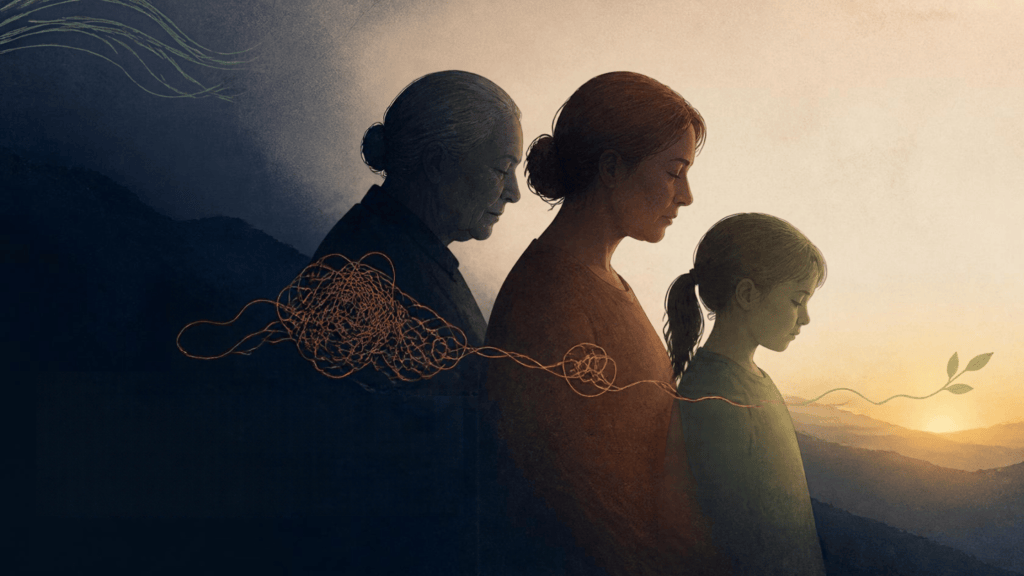
“You are not broken. You are breaking cycles.”
There is a quiet grief that many people carry without knowing its name.
It appears as anxiety before opportunity. A fear of being “too much.” The inability to rest without guilt. The instinct to overachieve, overgive, or disappear.
Often we ask ourselves, “Why am I like this?”
A more compassionate question is: “Who carried this before me?”
This is the doorway into understanding generational trauma…the invisible inheritance that lives not only in family stories but also in nervous systems, beliefs and unspoken survival strategies. In my line of work and through my life experience, I have come to believe that healing is not simply about fixing ourselves…it is actually about becoming conscious enough to distinguish between what belongs to our soul and what belongs to our lineage.
We Inherit More Than Eye Color
Our ancestors did not pass down only genetics. They also passed down ways of surviving.
A grandmother who learned that silence kept her safe may unknowingly teach her children that emotions are dangerous. A grandfather who endured poverty may leave behind a deep fear of scarcity, even after abundance arrives. Parents who were never allowed tenderness may love their children fiercely yet struggle to express affection.
None of these patterns begin with malice. Most begin with survival. Trauma has a remarkable ability to disguise itself as personality.
“I’ve always been independent.”
“I don’t need anyone.”
“I have to earn love.”
“I can’t slow down.”
These statements often sound like identity, yet they may be echoes…voices that traveled across generations until someone finally paused long enough to listen.
The Threads We Cannot Always See
The image of threads connecting generations is a profound metaphor.
Each thread represents a pattern that once served a purpose.
- Survival
- Silence
- Fear
- People-pleasing
- Hyper-independence
- Unresolved grief
Notice that these are not flaws. They are adaptations.
A child who grows up around unpredictable anger becomes highly attuned to other people’s emotions. We later call this “people-pleasing.”
A family forced to survive hardship learns never to waste, never to trust ease, never to rest. We later call this “work ethic.”
A generation shaped by war, migration, discrimination or loss teaches emotional restraint because vulnerability once carried consequences.
The survival strategy outlives the situation that created it. The body continues preparing for storms that ended decades ago.
Your Nervous System Is Listening to History
Modern psychology teaches us that trauma affects the nervous system. Spiritual wisdom teaches us that suffering leaves energetic imprints. These truths do not compete. They complete one another.
Your nervous system is not simply reacting to today’s circumstances. Sometimes it is responding to yesterday’s unfinished story. This does not mean trauma is mystical punishment or inherited destiny. It means human beings are deeply interconnected.
We are living bridges.
The heartbeat inside your chest has been carried through countless lives before becoming yours. When you heal, you are not only changing your future. You are changing the meaning of your past.
The Difference Between Loyalty and Liberation
One of the greatest spiritual dilemmas is confusing love with loyalty. Many people remain loyal to family pain because they believe healing would somehow betray those who suffered before them.
“If my mother never rested, who am I to rest?”
“If my father carried everything alone, shouldn’t I?”
Yet true love does not require repeating suffering. Imagine standing before your grandmother, the woman who survived impossible circumstances. Would she truly want you to inherit only her wounds? Or would she secretly hope that someone, someday, would finally lay them down?
Healing honors our ancestors more deeply than imitation ever can. We respect their struggle by refusing to make it permanent.
What Healing Actually Looks Like
Healing is often romanticized as becoming endlessly peaceful. Real healing is quieter. It looks like noticing….
- You notice your shoulders tightening before saying “yes” when you want to say “no.”
- You notice guilt appearing when you choose rest.
- You notice fear speaking in your own voice.
Awareness is the first sacred interruption. Then comes compassion.
Instead of asking, “What’s wrong with me?” You ask, “What protected me?” This single shift transforms shame into curiosity. Curiosity opens the door that shame keeps locked.
Spiritual Practices That Heal and Break Cycles
Healing generational trauma is both psychological and spiritual because it requires changing internal beliefs while reclaiming the soul’s original freedom.
1. Witness Without Judgment
Become the compassionate observer. Notice recurring emotional patterns without making them your identity. You are witnessing history, not becoming it.
2. Grieve What Was Never Given
Many people grieve only what they lost. Healing also requires grieving what was never received. The safety. The affection. The permission to be fully yourself. Grief creates space where denial once lived.
3. Create New Boundaries
Boundaries are not walls. They are sacred architecture. Every healthy boundary tells your nervous system: “The danger is no longer in charge.”
4. Speak the Unspeakable
Generational trauma thrives in silence. Healing begins when someone finally says, “This happened.” “I felt alone.” “I deserve something different.” Truth breaks curses that silence protects.
5. Choose Conscious Rest
Many inherited wounds teach us that worth must be earned. Rest becomes revolutionary. Each moment of intentional stillness tells your body that survival is no longer your only purpose.
You Become the Turning Point, the Cycle Breaker
Every family has someone who becomes the turning point, the cycle breaker. Not because they are stronger but because they become conscious. They recognize inherited fear without surrendering to it. They allow themselves to cry where others had to stay composed. They forgive without forgetting. They create homes where emotional safety becomes ordinary instead of exceptional.
This is sacred leadership. You may never know the full impact. A child raised in emotional security may never realize they were spared generations of hidden burdens.
That is how healing works. Its greatest victories often become invisible because suffering is no longer the norm.
The Ancestors Walk Beside You
From a spiritual perspective, I like to imagine that our ancestors are not merely behind us. They are beside us. Some whisper fear because fear was all they knew. Others whisper courage because they dreamed of a future they would never live to see. Perhaps healing is learning which voice to follow. Not every inheritance deserves preservation.
Some deserve blessing. Some deserve gratitude. Some deserve release.
A Prayer for the Cycle Breaker
May I honor those who came before me without becoming imprisoned by their pain.
May I recognize survival where I once saw weakness.
May I soften where fear taught me to harden.
May my boundaries become blessings.
May my tears water the ground where future generations will stand.
May the love that could not fully reach me flow freely through me.
And may I remember this sacred truth: I am not abandoning my family by healing. I am becoming the answer to prayers they may never have known how to speak.
Healing is not the rejection of our lineage…it is its evolution.
The threads that once carried fear can become bridges that carry wisdom. And when one person chooses awareness over automatic survival, an entire family tree begins to breathe and heal differently.

If you’d like 1-on-1 counseling sessions and spiritual guidance with me, come on over here.
Thank you SO much for your presence here! I appreciate it! If you’re NEW here, please subscribe for free updates and special gifts by Email. I publish New mental health, emotional healing, and spiritual growth articles every week!

